



Imagine it is 2:00 AM after a record-breaking sales day. You already know how to sell a product online, and your recent marketing campaign worked perfectly. However, instead of celebrating your success, you are staring at a mountain of unprinted shipping labels and a spreadsheet that does not match your current stock. Find the best dropshipping order management.
That frustrating gap between a customer clicking “Buy” and a package arriving at their door is called “The Invisible Middle.” It involves verifying addresses, updating stock counts, and sending tracking emails. Doing these tasks by hand works for ten orders, but it quickly becomes the exact tipping point where manual work stunts growth.
What if you could hire a reliable staff member who never sleeps or takes a break? Enter Automated Order Processing (AOP). Think of AOP using the “Invisible Assistant” framework: a digital helper that instantly checks your stock, notifies the warehouse, and generates a tracking number before you even wake up.
Industry data reveals that fulfillment errors jump significantly once a business crosses fifty manual shipments per week. Your new digital assistant mirrors your manual steps instantly, bridging the gap between your website and your shipping box without the risk of typos. Evaluating your current setup highlights exactly where automation will make the biggest impact.
Here are 4 common signs that your manual process is breaking:
- The “Out of Stock” Apology: You frequently have to email customers to cancel orders because you accidentally oversold an item.
- Shipping Label Typos: Packages bounce back to you because a human fingerslipped a street number during manual data entry.
- The Weekend Trap: Taking a Saturday off means spending your entire Sunday desperately trying to catch up on shipping boxes.
- Inventory Blindness: Your website numbers rarely match the actual physical boxes sitting in your spare room or garage.
Recognizing these warning signs is the first crucial step toward reclaiming your time. Scaling ecommerce operations through automation removes the anxiety of a sudden sales spike. Instead of dreading a busy holiday rush, you can confidently let your software handle the heavy lifting.
Embracing this technology transforms your daily routine from chaotic survival into sustainable business expansion. You have already mastered getting eager customers to your store. Now, it is time to let automation build a flawless bridge straight to their front doors.
The Real Cost of Manual Typing: Why Every Keypress is a Risk
Picture a busy Tuesday where you manually copy 100 customer addresses from your website to your shipping software. Even a tiny 2% error rate means two packages are heading to the wrong state. Those two typos cost you replacement inventory, expensive return shipping fees, and stressful customer apologies.
This tedious cycle is known as Double Entry—typing the exact same customer details into two different programs. When comparing manual vs automated order management systems, this repetitive copying is your biggest hidden expense. You are basically paying yourself or your staff to do the work of a robot.
Learning how to reduce manual order entry errors becomes effortless when you use a tool called Data Mapping. Think of this as a digital translator. It instantly links the “Name” box on your checkout page directly to the “Name” box on your shipping label, completely replacing the need for human typing.
Once that digital setup is finished, customer details flow perfectly from checkout to fulfillment. Capturing the correct address automatically is a massive relief, but it is only the first step. Next, you must ensure that purchased item is actually sitting on your shelf, which means building a reliable bridge between your website and your warehouse to stop overselling.
Stop Overselling: The Bridge Between Your Website and Your Warehouse
Imagine sending an enthusiastic customer an email explaining that the handmade coffee mug they just bought is actually out of stock. This painful apology usually happens when you expand into multi-channel selling—offering your products on your own website, Amazon, and Etsy simultaneously. While being on multiple sites brings in more revenue, it also creates a dangerous race where two people can buy your last remaining mug at the exact same time.
Fixing this requires a concept called Master Inventory, which acts as the single source of truth for your stock levels. Instead of manually updating a spreadsheet, automation creates a digital bridge between your sales platforms and your stockroom. This process, known as inventory synchronization across multiple sales channels, instantly lowers the available count everywhere the moment a single item is purchased on any site.
Setting a rapid sync frequency—how often the software updates your stock—unlocks crucial real-time inventory tracking benefits. This continuous digital vigilance protects your brand’s reputation in three specific ways:
- Eliminates the need to hide “just-in-case” buffer stock.
- Prevents angry one-star reviews caused by sudden order cancellations.
- Frees you from obsessively refreshing storefronts to manually adjust numbers.
Once your stock levels are safely synchronized, you can confidently take on a massive influx of buyers without the fear of overselling. The next challenge is getting those perfectly tracked items into your customers’ hands as quickly as possible, which requires a system that acts like a traffic controller: routing orders to the fastest warehouse.
The Traffic Controller: Routing Orders to the Fastest Warehouse
Picture the moment your business grows enough to store inventory in multiple locations, like your home garage in Ohio and a partner facility in Nevada. When a customer in California buys a sweater, someone has to decide which location should physically pack and ship it. Making this choice manually for hundreds of daily orders is a quick recipe for burnout and wasted postage.
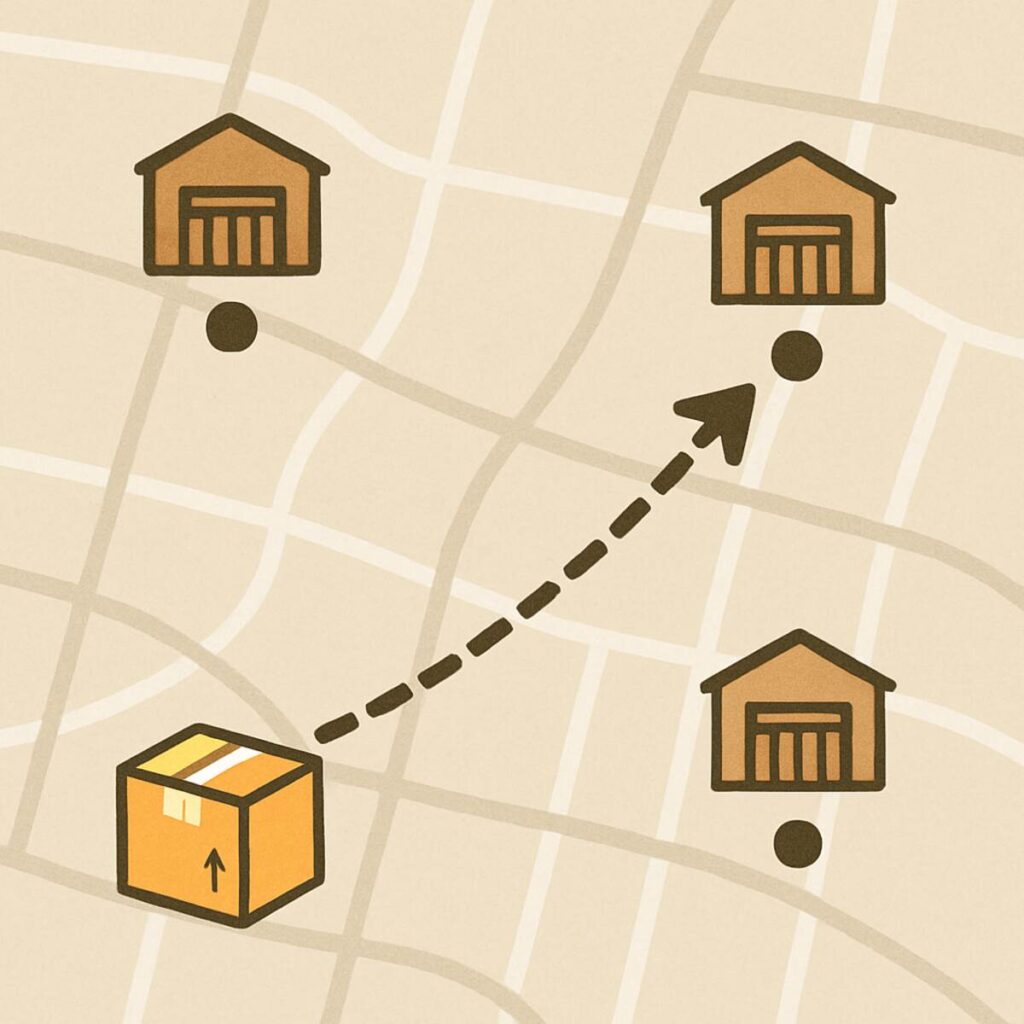
To solve this, growing businesses rely on smart software that acts as an invisible traffic controller. A distributed order management system is simply a digital assistant that instantly calculates the best fulfillment location based on a buyer’s address. By utilizing “geographic routing”—always sending the item from the building closest to the customer—you are dramatically reducing order lead time with automation while easily saving $2 to $5 per package on shipping costs.
Sometimes the closest facility might not have every single item the customer requested. Without automated rules in place, a tired employee might accidentally trigger a “split shipment,” where two separate boxes are mailed from two different places, immediately doubling your costs. The system prevents this expensive mistake by scanning all your stockrooms in milliseconds and automatically sending the request to the one location that holds the complete order.
Once this software confidently handles the “where does this ship from” decision, the physical fulfillment process begins instantly. The correct warehouse receives the green light, leaving just one final step before the box leaves the dock: getting the actual postage ready without typing everything out by hand.
Label Generation in Seconds: Cutting the Cord on Manual Shipping
Copying and pasting customer addresses into a carrier website for fifty orders is a tedious chore that practically invites misdirected packages. Instead of that manual chaos, modern systems use “batch printing.” With a single click, you can generate fifty perfect labels at once. By eliminating this data-entry bottleneck, small business owners can easily reclaim 10 hours of labor per week to focus on actual growth.
The software also acts as a financial advocate through a process called “rate shopping.” Rather than manually logging into multiple carrier accounts to compare prices, the system connects to them simultaneously to find the cheapest option. One of the greatest benefits of automated shipping label generation is watching this invisible process happen. Between the moments of “Order Paid” and “Label Printed,” the system instantly:
- Verifies the customer’s delivery address is a real location.
- Compares postage rates across your linked shipping carriers.
- Selects the lowest-cost service that meets the delivery deadline.
True workflow automation ensures that when you walk over to the printer, the hardest decisions are already made and the postage is paid. However, having a stack of prepaid stickers is only half the battle. Now you face the physical challenge of getting the correct products into the matching boxes—directing your warehouse team efficiently to avoid the picking and packing speed trap.
The Picking and Packing Speed Trap: How to Direct Your Warehouse Team
Imagine pacing back and forth across your storage room ten times to fulfill five simple orders. This constant backtracking is the hidden “walking distance” cost that quietly drains your team’s energy and delays shipments. Without a smart system, streamlining warehouse picking and packing processes feels like navigating a physical maze blindfolded.
Instead of handing an employee a stack of random printed receipts, automation generates optimized pick-lists. Think of a pick-list as a highly organized grocery shopping guide that tells you exactly which aisle and shelf holds the needed product. By directing your staff precisely, this digital roadmap practically eliminates frustrating “wrong item” returns while greatly improving order accuracy in ecommerce.
To speed things up further, the software introduces a strategy called wave picking. Rather than fulfilling one complete order at a time, the system acts like a traffic controller by grouping similar items together in “waves.” If three different customers ordered the same handmade vanilla candle, your team grabs all three candles during a single quick trip to that specific shelf.
Grouping tasks this way dramatically cuts down fulfillment time, allowing a small boutique to handle hundreds of daily orders without hiring extra help. Once those correct items are securely taped inside their boxes, the physical labor finally ends. The next crucial step is making sure your waiting buyers know their packages are actually on the way.
Keeping Customers in the Loop: Automated Tracking and Peace of Mind
Every small business owner eventually faces a flooded inbox filled with the exact same question. In the ecommerce industry, this is known as WISMO—”Where Is My Order?” Handling these repetitive support tickets manually drains hours of your week. Instead of hunting through shipping receipts to answer emails, automation acts as an invisible assistant that updates buyers before they even ask.
The secret here involves “triggered emails,” which are messages sent automatically the moment a shipping carrier scans a package’s barcode. By utilizing centralized customer order tracking solutions, your software translates physical box movements into instant digital notifications. To provide excellent order tracking, your automated system should hit four essential communication milestones:
- Order Confirmation: The instant a purchase is finalized online.
- Shipped: When your team officially prints the shipping label.
- Out for Delivery: When the package boards the local delivery truck.
- Delivered: The exact moment it safely arrives at the front door.
Hitting these specific touchpoints builds immense buyer trust while completely eliminating tedious manual status updates. An informed customer feels valued and remains loyal to your brand. Even with flawless shipping processes, you must prepare for the reality of returns and refunds.
Turning ‘Oops’ into Opportunity: Automating Returns and Refunds
Even successful stores face the reality of returns. When a buyer receives a sweater that doesn’t fit, forcing them to email you for a shipping label creates unnecessary friction. Instead, you can implement a self-service Return Portal. This dedicated webpage acts as a digital customer service desk, allowing shoppers to type in their order number and initiate the process themselves, completely bypassing your busy inbox.
Upon selecting their reason for sending the item back, the software instantly issues an RMA, or Return Merchandise Authorization. Think of an RMA as a digital permission slip telling your warehouse exactly what is coming back and why. Generating this slip effortlessly is the foundation of automated returns and refund management, turning a stressful multi-day email chain into a quick two-minute task for the buyer.
The real magic happens when that package physically arrives at your facility. As soon as your staff scans the return label, the system can automatically approve the customer’s refund based on warehouse receipt. Tracking these incoming items seamlessly also gathers critical data for improving order accuracy in ecommerce, like noticing if a specific product is consistently mislabeled or damaged in transit.
Smart automation even allows you to offer an instant exchange instead of a cash refund, saving the sale before the buyer ships the original box. To make all these moving parts communicate effortlessly, your storefront needs a central nervous system connecting your ERP directly to your shop.
The Brain of the Operation: Connecting Your ERP to Your Shop
Most business owners rely on accounting software to track their money. But a frustrating problem arises when your website, warehouse, and accounting tools don’t communicate. These disconnected systems create “Data Silos.” Your valuable information gets trapped in separate digital buckets, forcing you to manually copy and paste numbers late at night.
To break down these walls, growing businesses use an ERP, or Enterprise Resource Planning system. Think of an ERP as the master brain of your company. It creates a “Single Source of Truth”—a central hub where your inventory, sales, and finances are always perfectly matched, so you never second-guess your numbers again.
Imagine a boutique selling handmade candles across multiple platforms. With proper ERP integration for online retailers, a customer’s purchase instantly updates the bank ledger and reduces warehouse stock simultaneously. This seamless automated order processing completely eliminates the tedious need for manual data syncing between your accounting team and your storefront.
Preparing your digital infrastructure this way makes high-volume growth manageable instead of terrifying. Once your central software brain is running smoothly, you can seamlessly handle hundreds of daily purchases without burning out or hiring extra data-entry staff. Eventually, your physical storage might run out of space, making a 3PL the next logical step to scale without growing pains.
Scaling Without Growing Pains: When to Bring in a 3PL
Does your living room currently look like a cardboard box factory? Successful businesses eventually outgrow their personal spaces, which is exactly when owners partner with a 3PL (Third-Party Logistics) provider. A 3PL operates a fulfillment center—a specialized warehouse that stores your items, packs your orders, and hands them to delivery carriers. Delegating this physical labor lets you focus entirely on marketing and growth while professionals handle the tape and bubble wrap.
Recognizing the exact moment to outsource your shipping usually involves looking for these three signs you are ready to move from your garage to a 3PL:
- You spend more hours packing daily orders than designing new products or campaigns.
- Your spare bedroom or office has completely run out of physical storage shelves.
- You hesitate to launch major promotions because you dread the overwhelming shipping workload.
When you make this leap, proper 3PL integration for ecommerce scaling acts as your digital supervisor. Behind the scenes, your central software talks directly to the fulfillment center, granting you “Invisible Control” over outsourced shipping without ever lifting a finger. This multi-channel fulfillment workflow optimization means an order placed anywhere online instantly alerts your 3PL to pack the correct box. You get the peace of mind of a fully staffed warehouse, minus the daily management headaches. A structured 90-day automation roadmap turns this vision into reality.
Your 90-Day Automation Roadmap: How to Start Today
You no longer have to view a sudden surge in sales as a looming mountain of stress. Instead of bracing for late nights printing labels and cross-checking spreadsheets, you now know how to build an invisible assistant that handles the busy work for you. The goal isn’t just about shipping boxes faster; it is about reclaiming your 2:00 AMs and getting your peace of mind back.
Implementing Automated Order Processing for Ecommerce Order Management doesn’t mean you have to flip a massive switch overnight. Think of it like hiring a new team member. You wouldn’t hand them every single job on their very first day. You start small, letting them take over the most repetitive, time-consuming tasks while you focus on growing your store.
True workflow automation works best when it solves your specific bottlenecks one by one. By breaking the transition down into manageable chunks, you can safely move from a manual, error-prone routine to a smooth, rules-based engine. Following a targeted implementation checklist allows you to transition safely and reclaim your time.
Here is your 4-week step-by-step implementation checklist:
- Week 1: Conduct a Time Audit. Keep a notepad by your desk for three days. Write down every manual task you do when a purchase happens, from copying customer addresses to adjusting your stock numbers.
- Week 2: Create a Priority List. Look at your audit and circle the tasks that cause the most shipping errors or take the most hours. Pick just one specific chore—like label printing or inventory syncing—to automate first.
- Week 3: Select your first piece of automation software. Research simple tools designed to solve your top priority. Look for beginner-friendly platforms that connect directly to your website with a few clicks.
- Week 4: Test with one product. Turn the new system on for a single item in your store. Place a test order yourself to watch your software work from start to finish.
Once you complete that first test, the technical mystery fades away. You will see an order come in and watch the software instantly mirror what you used to do by hand. Every time a tracking number sends itself or a stock level updates automatically, you will build the confidence to tackle the next task on your list.
Your business should serve your life, not the other way around. Tomorrow morning, before you pack a single box or fulfill a single customer request, grab a notepad and start your time audit. Automating your busy work finally gives you the freedom to focus entirely on building your store’s future.