

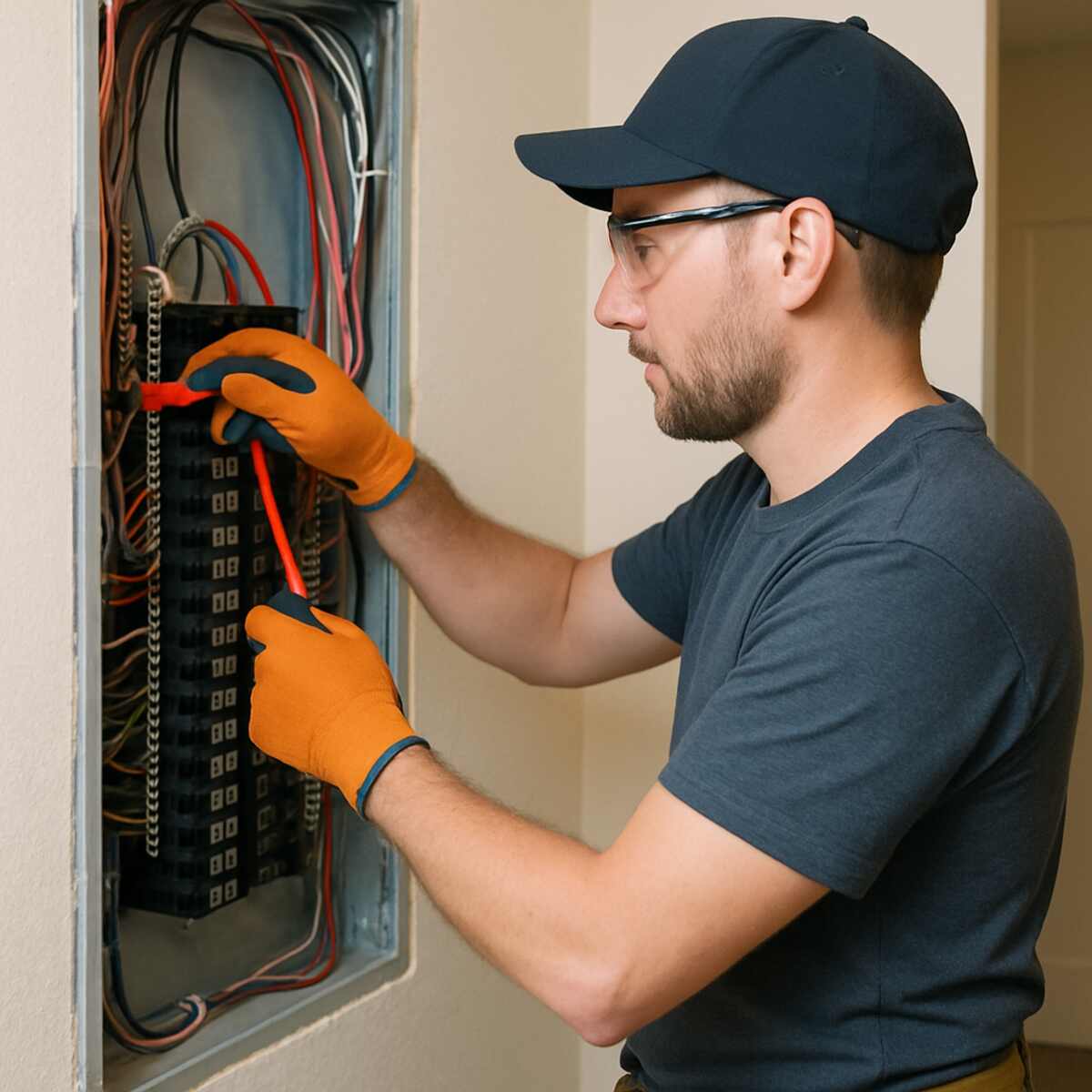

Imagine your home as a living, breathing entity. The plumbing represents the veins, the framing is the skeleton, and the electrical panel is the beating heart. Every time you turn on a light, charge your smartphone, run the dishwasher, or plug in your electric vehicle, you are asking that heart to pump energy safely and efficiently throughout your home. The best guide to finding electrician Highlands Ranch CO.
But what happens when that heart is decades old, struggling to keep up with the demands of a modern, technology-driven lifestyle?
Over the past few decades, our electrical consumption has skyrocketed. We have transitioned from homes with a single television and a few basic appliances to fully connected smart homes boasting high-efficiency HVAC systems, multiple computers, massive refrigerators, and high-capacity electric vehicle (EV) chargers. If your home was built more than twenty years ago, there is a high probability that its original electrical infrastructure was never designed to handle today’s heavy electrical loads.
This comprehensive guide will walk you through the immense benefits of investing in an electrical panel upgrade. We will explore everything from recognizing the warning signs of a failing system to understanding the latest smart home energy tech. Whether you are planning a major renovation, prioritizing your family’s safety, or simply tired of resetting tripped breakers, upgrading your electrical panel is one of the most vital investments you can make in your property.
What Exactly Is an Electrical Panel?
Before diving into the benefits of an electrical panel upgrade, it is crucial to understand what this metal box actually does. Often referred to as a breaker box, load center, or distribution board, the electrical panel serves as the central distribution point for your home’s electrical system.
Power from your local utility company flows through the meter outside your home and directly into this panel. From there, the panel divides the main electrical power into smaller, manageable subsidiary circuits. Each of these circuits provides power to specific rooms, appliances, or lighting zones.
Most importantly, the panel acts as your home’s primary safety gatekeeper. If a circuit draws more current than it is designed to handle, the circuit breaker trips, instantly cutting off the flow of electricity to prevent the wires from overheating and potentially starting a fire.
The Shift from Fuses to Breakers
If you live in an older home, you might have a fuse box rather than a modern breaker panel. When looking at a fuse box vs circuit breaker panel, the fundamental difference lies in how they handle overloads.
Fuses contain a small metal wire that physically melts (or “blows”) when too much current passes through it. Once a fuse blows, it is permanently destroyed and must be unscrewed and replaced with a new one. Circuit breakers, on the other hand, use an internal switch mechanism that simply trips and can be easily reset with the flip of a switch. Today, fuse boxes are considered obsolete. They are inherently less safe because homeowners often replace blown fuses with incorrectly sized ones, creating a severe fire hazard.
Top Signs of an Outdated Electrical Service
How do you know if it is time for an electrical service upgrade? Your home will usually give you warning signs before a catastrophic failure occurs. Ignoring these symptoms can lead to damaged electronics, inconvenient power outages, or even devastating electrical fires.
Here are the most common signs of an outdated electrical service that require immediate attention:
1. Flickering or Dimming Lights
Do your living room lights dim for a second when the refrigerator compressor kicks on? Or perhaps you experience flickering lights caused by overloaded circuits when you run the microwave and the toaster simultaneously. This occurs because your panel does not have the capacity to deliver the sudden surge of power required by heavy motorized appliances, starving your lighting circuits of electricity.
2. Frequent Breaker Trips
Circuit breakers are designed to trip occasionally to protect your home. However, if you find yourself walking to the basement or garage multiple times a week to reset the same breakers, your system is crying out for help. A constantly tripping breaker means you are regularly exceeding the safe capacity of that circuit.
3. Visual and Olfactory Warnings
Electricity should be invisible and odorless. If you ever notice the following, you need to contact a professional immediately:
- Burning smells: A fishy or acrid burning plastic smell near your panel or outlets indicates melting wire insulation.
- Warm panels: Your electrical panel should always feel cool to the touch. If the metal cover is warm or hot, the internal components are dangerously overloading.
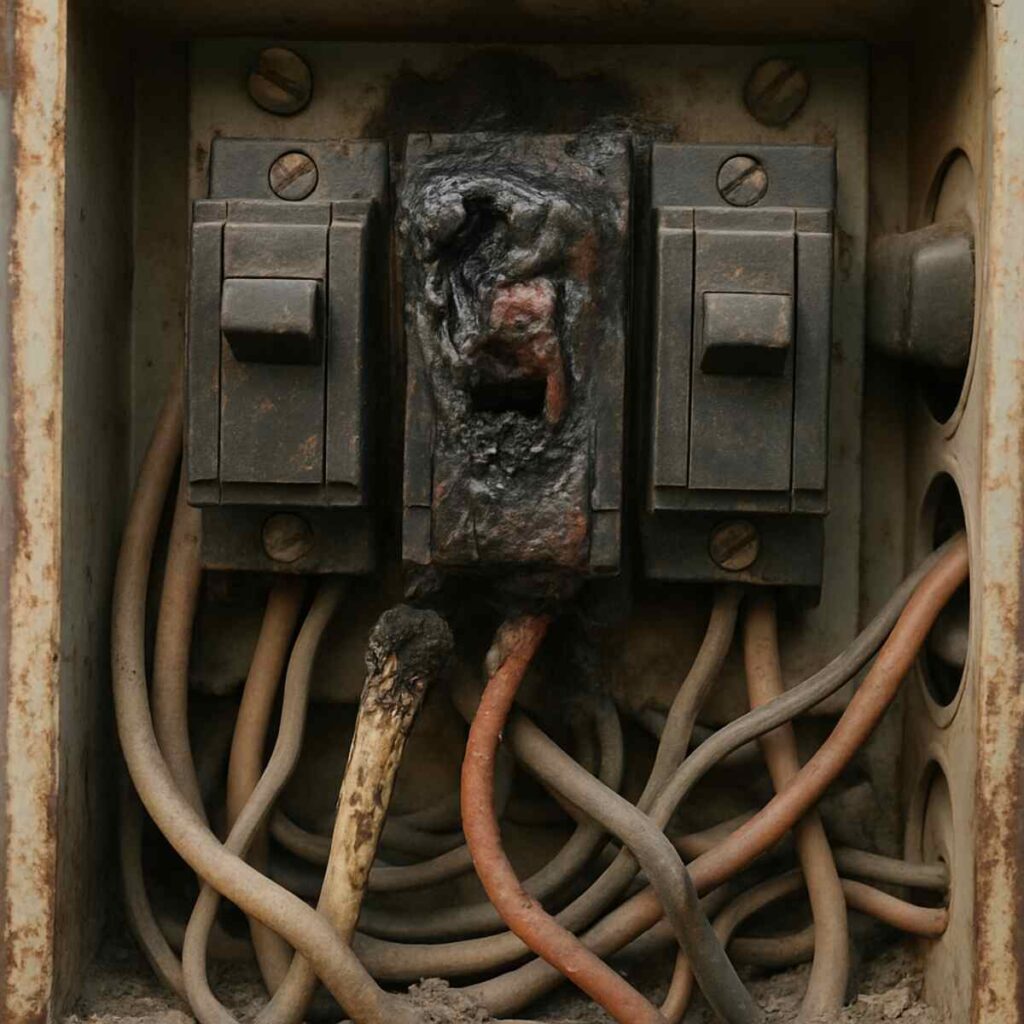
- Scorch marks: Black or brown burn marks around breakers, outlets, or switches are evidence of minor electrical fires that have already occurred.
- Rust and corrosion: Moisture and electricity are a deadly combination. If you see rust on your panel, it means water has intruded, compromising the integrity of the connections.
The Hidden Threat: Dangerous Federal Pacific or Zinsco Panels
Not all electrical panels are created equal. If your home was built or renovated between the 1950s and the 1980s, you might have a hidden danger lurking in your hallway or basement. Millions of homes were equipped with panels that have since been proven to be inherently defective.
The two most notorious brands are Federal Pacific Electric (FPE) Stab-Lok panels and Zinsco panels.
Why Are FPE and Zinsco Panels Dangerous?
Extensive testing by the Consumer Product Safety Commission (CPSC) and independent experts revealed that the breakers inside dangerous federal pacific or zinsco panels frequently fail to trip during an overload or short circuit.
Instead of cutting the power, the defective breakers allow massive amounts of electrical current to continue flowing. This causes the wires to superheat, melt their insulation, and ignite surrounding building materials. Furthermore, Zinsco panels are prone to an issue where the breakers actually melt and fuse to the main bus bar, making it impossible for them to trip at all.
If you open your panel door and see the names “Federal Pacific,” “Stab-Lok,” “Zinsco,” “GTE Sylvania,” or “Kearney,” you should immediately schedule an electrical panel replacement. Many homeowner’s insurance companies will completely deny coverage or cancel your policy if they discover these panels on your property.
How Many Amps Does My Home Require?
A common question homeowners ask during renovations is, “how many amps does my home require?”
Amperage (amps) is the measurement of the volume of electricity flowing into your home. The main breaker in your panel dictates your home’s total electrical capacity. Here is a breakdown of common service sizes:
- 60 Amps: Found in homes built before the 1950s. This is entirely insufficient for a modern home and is considered a massive safety hazard today.
- 100 Amps: The minimum code requirement for a typical small home without central air conditioning or electric heating. If you have gas appliances (stove, water heater, furnace), you might scrape by with 100 amps, but you will lack room for expansion.
- 150 Amps: A middle-ground service found in many late-20th-century homes. It supports basic modern appliances but struggles with EV chargers and hot tubs.
- 200 Amps: The gold standard for modern homes. A 200 amp service entrance installation allows you to run multiple heavy-draw appliances simultaneously, such as central HVAC, electric ovens, clothes dryers, and an electric vehicle charger, without breaking a sweat.
- 400 Amps (or higher): Typically reserved for large luxury homes over 4,000 square feet, homes with extensive electrical heating systems, or properties with massive outbuildings, dual EV chargers, and heavy-duty workshop equipment.
Calculating Your Load
To truly answer how many amps you need, an electrician will perform an “electrical load calculation.” This mathematical formula takes into account your home’s square footage, the wattage of all your permanent appliances, lighting, and HVAC systems. If your calculation exceeds 80 amps, you mathematically require more than a 100-amp panel to allow for a safe 20% buffer.
The Process of a 200 Amp Service Entrance Installation
Deciding to upgrade to 200 amps is the most common and beneficial route for modern homeowners. But this involves more than just swapping the metal box on your wall.
A proper 200 amp service entrance installation upgrades the entire pathway of electricity from the utility pole to your breakers. The process generally includes:
- The Weatherhead and Mast: The pipe protruding from your roof where utility wires connect to your home. The internal wires must be thickened (usually to 4/0 aluminum or 2/0 copper) to carry 200 amps safely.
- The Meter Base: The socket that holds the utility company’s glass meter must be physically enlarged to handle the increased load.
- The Service Entrance Cable: The thick cable running from the meter down into your electrical panel.
- The New Panel: The installation of a high-capacity breaker box featuring a 200-amp main breaker and plenty of slots for individual branch circuits.
Because this upgrade requires coordination with your local utility company to briefly disconnect your home from the power grid, it is a highly orchestrated project that requires a trained professional.
Essential Protections: Modern Safety Features
One of the greatest benefits of an electrical panel upgrade is the ability to integrate cutting-edge safety technologies that simply did not exist a few decades ago. Upgrading your panel isn’t just about getting more power; it is about getting safer power.
Arc Fault Circuit Interrupter Installation (AFCI)
You are likely familiar with Ground Fault Circuit Interrupters (GFCIs)—the outlets with the “test” and “reset” buttons found in bathrooms and kitchens. GFCIs protect you from fatal electric shocks where water is present.
However, modern code requires something different for living spaces: arc fault circuit interrupter installation. An electrical arc happens when electricity jumps (or “arcs”) through the air between loose connections, broken wires, or wires pierced by a nail in the wall. These arcs generate temperatures upwards of 10,000 degrees Fahrenheit, easily igniting wood framing and drywall.
Standard breakers cannot detect arcs. AFCI breakers contain advanced microprocessors that monitor the electrical waveform. If they detect the specific, erratic signature of an electrical arc, they trip instantly. Today, installing AFCI breakers during an electrical panel replacement is one of the most effective ways to prevent residential fires.
Whole House Surge Protector Benefits
Many homeowners mistakenly believe that the cheap plastic power strip under their desk provides adequate surge protection. In reality, a massive power surge—such as a lightning strike or a grid fluctuation—will bypass those strips instantly.
One of the standout whole house surge protector benefits is that it installs directly into your new electrical panel. When a surge hits your home, this device detects the voltage spike at the source and safely shunts the excess electricity directly into the earth before it can enter your home’s branch circuits.
Consider the electronics in your home: smart refrigerators, OLED televisions, computers, washers with digital displays, and your HVAC control boards. A single power surge can fry tens of thousands of dollars worth of equipment in a millisecond. A whole-house surge protector acts as a formidable, affordable shield for your entire property.
Grounding and Bonding System Requirements
Older homes often feature outdated or non-existent grounding systems. Grounding provides a safe, alternative path for runaway electricity to return to the earth rather than traveling through your body or your home’s structure.
Modern electrical codes are incredibly strict regarding grounding and bonding system requirements. During an upgrade, your electrician will ensure your panel is properly bonded to your home’s metallic water piping and connected to two copper grounding rods driven deep into the earth outside your home. This vital safety step stabilizes your home’s voltage and dramatically reduces the risk of electrocution during a short circuit.
Taking Control: Smart Electrical Panel Energy Monitoring
We are entering a golden age of smart home technology, and electrical panels are no exception. If you are pursuing an electrical service upgrade, you now have the option to install a “smart panel,” such as those manufactured by SPAN or Leviton.
Smart electrical panel energy monitoring offers unprecedented control over your home’s power consumption. These panels connect to your home’s Wi-Fi and allow you to view your electrical usage in real-time via a smartphone app.
Why Choose a Smart Panel?
- Appliance-Level Tracking: See exactly how much electricity your air conditioner, EV charger, or dryer is consuming at any given moment. This helps you identify energy hogs and lower your monthly utility bills.
- Remote Control: Did you forget to turn off the oven or the curling iron? You can remotely switch off individual circuits from your phone, no matter where you are in the world.
- Solar and Battery Integration: If you plan to install solar panels or battery backup systems (like the Tesla Powerwall), smart panels allow for dynamic load shedding. During a grid outage, the panel can automatically shut off non-essential circuits (like the pool pump) to preserve battery life for critical loads (like the refrigerator and medical equipment).
Adding a Subpanel for Home Renovations
Sometimes, a complete overhaul isn’t necessary. If your current main panel is modern, safe, and has a high enough overall amperage capacity (e.g., a modern 200-amp panel), but you have simply run out of physical slots for new breakers, you have another option.
Adding a subpanel for home renovations is a highly cost-effective strategy. A subpanel is a smaller, secondary breaker box that receives its power from a large breaker in the main panel.
This is incredibly useful when:
- Finishing a basement: You can install a subpanel in the basement to cleanly route all the new lighting and outlet circuits locally.
- Building a detached garage or workshop: Running one thick feeder wire from the house to a garage subpanel is much cheaper and easier than running ten separate circuit wires underground.
- Installing a heavy-duty kitchen: Routing appliances directly to a nearby subpanel can simplify the wiring process during a massive kitchen remodel.
However, remember that adding a subpanel does not increase the total power capacity of your home. If your main panel is only 100 amps, adding a subpanel will not magically give you 200 amps of power.
Complying with the Law: National Electrical Code Standards
Every electrical panel replacement must adhere to rigorous safety protocols. In the United States, these rules are governed by the National Fire Protection Association (NFPA) through a publication known as the NEC.
Meeting National Electrical Code compliance standards is not merely a suggestion; it is a legal requirement for passing municipal inspections. The NEC updates its standards every three years to adapt to new technologies and safety data.
For example, recent NEC updates mandate specific clearances around the electrical panel (usually 36 inches of depth, 30 inches of width, and 78 inches of height) to ensure emergency responders and electricians have safe working access. It also dictates where panels cannot be installed, such as inside clothes closets or bathrooms, due to moisture and fire risks. Upgrading your panel ensures your home is brought up to modern legal standards, protecting you from liability.
Understanding the Investment: The Cost to Replace a Residential Breaker Box
When planning an upgrade, budgeting is naturally a top concern for homeowners. The cost to replace a residential breaker box varies significantly based on several factors, including your geographic location, the size of the upgrade, and the current condition of your home’s wiring.
While exact prices fluctuate, here is a general breakdown of what dictates the final bill:
1. Scope of the Upgrade
- Panel Swap Only: If you already have a 200-amp service entrance and simply need to replace a dangerous Zinsco panel or an old fuse box with a modern 200-amp breaker panel, the cost generally ranges between $1,500 and $2,500.
- Full Service Upgrade (100A to 200A): If you need the full 200 amp service entrance installation (new weatherhead, meter base, thicker cables, and panel), the materials and labor drastically increase. This typically costs between $2,500 and $4,500.
- Smart Panels: Opting for smart electrical panel energy monitoring systems (like SPAN) will increase the material costs significantly, often pushing the total project cost to $4,000 – $6,000+.
2. Required Repairs and Code Updates
Electricians often uncover hidden issues when opening up walls. You may need to pay extra for upgraded grounding and bonding system requirements, repairing frayed wires, or installing expensive AFCI breakers (which cost $40-$60 each, compared to $5 for standard breakers).
3. Permits and Inspections
Your contractor will need to pull a permit from your local municipality. Permit fees typically range from $100 to $300 and include a visit from a city inspector to verify the work meets National Electrical Code compliance standards.
While this may seem like a significant upfront cost, it is a one-time investment that drastically improves your home’s safety, readies it for modern technology (like EVs), and adds measurable resale value.
Planning the Day: How Long Does Electrical Service Replacement Take?
Many homeowners delay upgrades out of fear of living without electricity for days on end. Fortunately, this is a misconception. So, exactly how long does electrical service replacement take?
In the vast majority of residential cases, the entire physical replacement is completed in a single day, typically between 6 to 8 hours.
Here is what a typical upgrade day looks like:
- Morning (8:00 AM): The licensed electrician arrives. The utility company may also arrive to disconnect the power at the street or the pole. (Power goes out).
- Mid-Morning (9:00 AM – 12:00 PM): The old panel, meter base, and exterior cabling are completely removed. The new exterior meter base and weatherhead are installed.
- Early Afternoon (12:00 PM – 3:00 PM): The new breaker panel is mounted. The electrician meticulously routes, trims, and connects all the branch circuit wires into the new breakers, ensuring everything is properly balanced and grounded.
- Late Afternoon (3:00 PM – 4:00 PM): The municipal inspector arrives to review the work. Once the inspection is passed, the utility company is given the “green light” to safely reconnect the power grid to the home. (Power is restored).
- Wrap Up (4:00 PM – 5:00 PM): The electrician tests every circuit, labels the new panel clearly, cleans up the work area, and guides you through the new features.
While you will be without power during normal business hours, you will generally have your lights and HVAC running again by dinner time.
The Critical Importance of Hiring a Licensed Electrical Contractor
With the rise of internet tutorials and DIY home improvement shows, some ambitious homeowners may consider attempting to upgrade their panels themselves to save money. Let us be entirely clear: upgrading an electrical panel is absolutely not a DIY project.
The electrical current entering your main service lines before the main breaker is entirely unfused. Touching the wrong wire can result in instantaneous, fatal electrocution. Furthermore, even a minor mistake in tightening a neutral lug or balancing a load can create a slow-burning resistance point that could burn your house down months later.
This is why hiring a licensed electrical contractor is non-negotiable.
Why You Need a Pro
- Safety and Expertise: Licensed electricians have undergone thousands of hours of apprenticeship and training. They understand the nuances of electrical theory, load calculations, and complex code requirements.
- Liability and Insurance: If a DIY electrical job causes a fire, your homeowner’s insurance company will investigate. When they find unpermitted, unlicensed work, they will likely deny your claim, leaving you financially devastated. A licensed contractor carries their own liability insurance to protect your property.
- Coordination: Upgrades require orchestrated communication between the contractor, the city permit office, the municipal inspector, and the local utility provider. A professional handles all this logistical red tape seamlessly.
- Warranties: Reputable contractors guarantee their labor and the materials they install, providing you with long-term peace of mind.
Maximize Your Home’s Potential
An electrical panel upgrade is far more than a simple maintenance chore; it is a foundational upgrade that future-proofs your entire home.
By replacing that old, outdated box, you are eliminating severe fire hazards like dangerous federal pacific or zinsco panels. You are clearing the path for the future, ensuring your home has the robust 200-amp capacity required for electric vehicles, solar arrays, and high-efficiency HVAC heat pumps. You are integrating advanced life-saving features like AFCI protection and whole-house surge shields.
If you are experiencing the warning signs of an outdated electrical service, or if you simply know your home is aging behind the walls, do not wait for an emergency to force your hand. Upgrading on your own terms allows you to budget properly, choose the best contractor, and select modern smart technologies that will serve your family for decades to come.
Take the first step toward a safer, more efficient home today. Walk over to your electrical panel, see what brand it is, and check the amperage on your main breaker. If you have any doubts about its age, safety, or capacity, call a licensed electrical contractor for a professional evaluation. Investing in your home’s electrical heart is the ultimate investment in your family’s safety and comfort.
