


Making a card game can feel like magic. We see a polished box on a store shelf and assume it was created in a flash of genius. The truth is more interesting and accessible: making a game is a craft. It’s a process of asking questions, scribbling on index cards, and playing wonderfully broken versions with your friends. If you have an idea and a pen, you have everything you need to begin. To learn more, check out ketua911
That idea—whether about duelling hamsters or space pirates hunting for treasure—is the only thing you truly need. The problem isn’t the idea; it’s the intimidating blank space between that spark and a playable game. What’s the first step? Do you design cards or write rules? The answer is to follow a simple, repeatable roadmap that turns your vision into a tangible experience.
Forget the myth of overnight inspiration. Nearly every successful game follows a three-stage journey. This process begins with the Blueprint, where you define your core idea and how someone wins. Next comes the Sketch, where you create a rough, physical version with paper and pen. Finally, you run the Reality Check—the crucial step of playing your messy creation to discover what’s fun and what’s broken.
You don’t need special software, artistic talent, or a design background to walk this path. Learning how to design your own card game is about permitting yourself to be imperfect and taking the first step. So grab some index cards, and let’s build your Blueprint.
First, Find Your ‘Spark’: How to Define Your Game’s Core Theme and Feeling
Every great card game starts with a simple spark, not a complex rulebook. This is your game’s Theme—its core story, setting, and characters, boiled down into a single sentence. Is your game about “wizards duelling in a magical library,” or “competitive gnomes trying to bake the best pie”? Before you think about rules, write that one-sentence description. This is the north star for your project, transforming a random pile of cards into a world.
With your theme set, ask yourself a crucial question: How do I want my players to feel? The Player Feeling is the emotional experience you’re creating. Do you want players to feel clever, as if they’ve outsmarted their opponents? Or should they feel lucky, laughing as chaotic events unfold, like in Exploding Kittens? A spy game might aim for tension, while a party game about ridiculous monsters aims for pure silliness. Choose one or two words that capture this emotional goal.
This combination of theme and feeling is your most powerful design tool. It acts as a compass, making future decisions surprisingly easy. When you’re stuck trying to invent a new card, ask, “Does this fit my theme of ‘space pirates’?” and “Does this make the player feel ‘daring and lucky’?” If the answer is no, you can discard the idea with confidence. Now that you have a direction, it’s time to give your players a destination.
What’s the Finish Line? Why a Clear Win Condition is Your Most Important Rule
Now that your game has a world and a feeling, your players need a purpose. A game without a goal is like a road trip without a destination. This goal is your game’s Win Condition, and it’s the single most important rule you will write. It answers the one question every player has: “How do I win?” This simple rule is the foundation for a good rulebook and the engine for player motivation.
Everything a player does will be shaped by this finish line. In Go Fish, the goal is to collect the most sets, so you spend turns asking for cards. In Poker, the goal is to have the best hand (or convince others you do), driving every decision to bet, fold, or raise. A clear objective gives every choice meaning. Without it, players are just drawing cards randomly.
Defining your win condition doesn’t have to be complicated. Most games use one of a few common types. Consider which of these might fit your theme:
- Score-Based: The first player to reach a certain number of points wins.
- Elimination: You win by being the last player left in the game.
- Collection: The first player to gather a specific set of cards wins (e.g., all four “Dragon” cards).
- Objective-Based: Be the first to complete a specific task, like moving a token to the final space on a track.
Choose one for your game and write it down. You can always change it later. With a clear destination in mind, we can focus on the journey.
Designing the ‘Engine’ of Fun: How to Create Your Game’s Core Loop
If the Win Condition is your destination, the Core Loop is the journey you take on every turn. Think of it as the chorus of a song—the main, repeatable part that forms the backbone of the experience. This simple sequence of actions is the engine of your game, pushing it forward turn after turn. It’s the fundamental rhythm players will learn instantly.
Take a game as simple as Go Fish. Its core loop is tiny: 1) Ask an opponent for a card, and 2) If they don’t have it, draw from the deck. That’s it. For Uno, the loop is: See if you can play a card that matches the last one, and if you can’t, draw one. You already know what a core loop feels like, even if you’ve never heard the term.
Your own game’s core loop should start simple. A great starting point for most card games is a three-step process: 1) Draw a card, 2) Take an action (like playing a card), and 3) End your turn. Write down your basic loop in one sentence. This simple structure provides the foundation for designing the cards players will use to win.
Building Your Deck: A Simple Guide to Creating Your First Card Types
Your game’s engine—the core loop—needs fuel. The cards are what players use to interact with that loop and win the game. Instead of inventing dozens of unique cards from scratch, group your ideas into a few simple Card Types. Think of these as job titles; each card has a specific role to play.
Start small. For your prototype, limit yourself to just two or three card types. This focus makes designing and balancing your game vastly easier. Most card ideas will fall into a few common categories:
- Resource Cards: These are the “money” or “fuel” of your game. Players collect them to spend on other things (e.g., ‘Gold’, ‘Energy’, ‘Mana’).
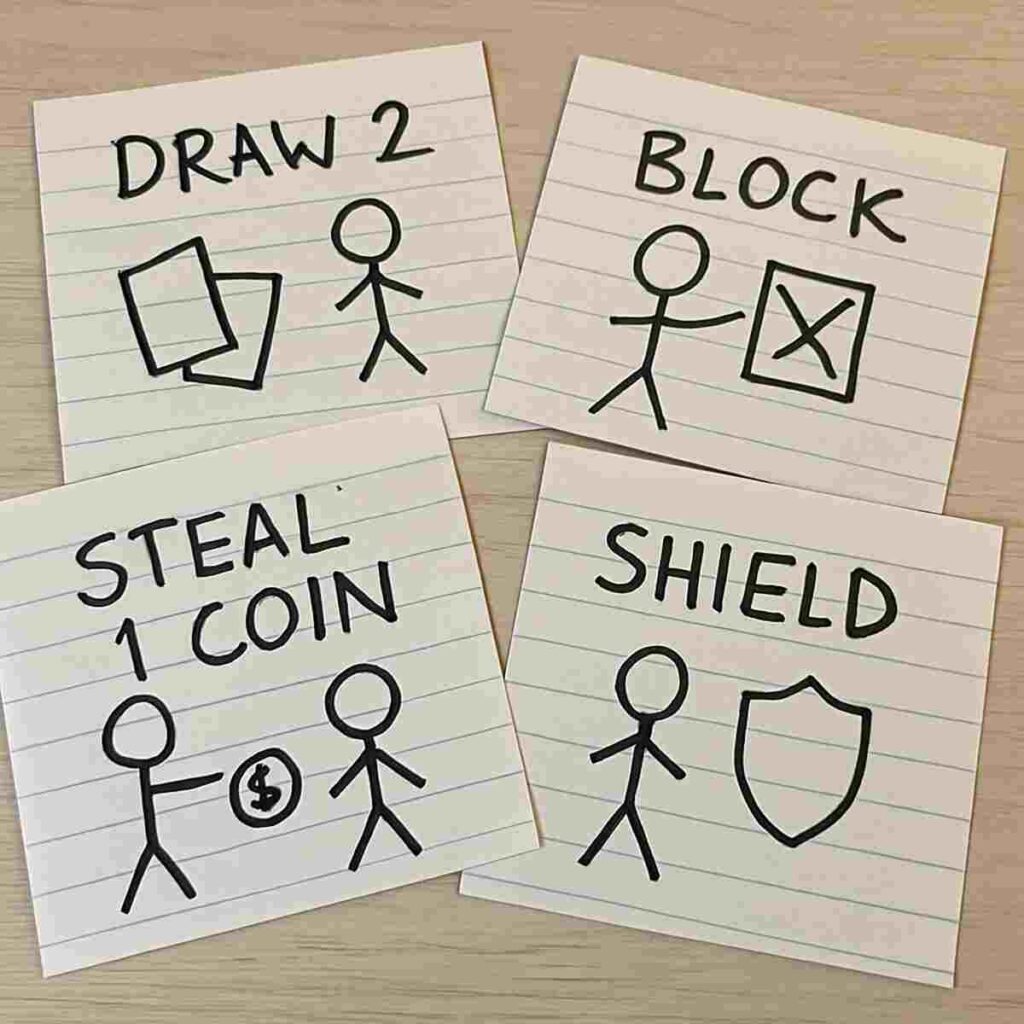
- Action Cards: These cards do something immediately and are then usually discarded (e.g., ‘Draw 2 Cards’, ‘Skip Next Player’, ‘Steal a Card’).
- Permanent Cards: These stay on the table and provide a lasting benefit or character (e.g., ‘Knight’, ‘Magic Amulet’, ‘Factory’).
With these categories in mind, think about your game’s theme and core loop. Does your game need resources to build things? Is it more about quick, direct actions? Choose two types that feel right, grab a piece of paper, and brainstorm five simple card ideas for each. Don’t worry about perfection; we’re just looking for rough sketches to bring to life.
Your First Prototype in 30 Minutes: All You Need is Index Cards and a Pen
You’ve brainstormed some card ideas; now it’s time to make them real. The fastest way to see if your game has potential is by creating a prototype: a simple, physical version made only for testing. The goal is speed, not beauty. Your most powerful tools are a pen and a stack of index cards. This quick-and-dirty approach is the first practical step in creating a card game prototype.
Your immediate goal is to build a Minimum Viable Deck. This is the absolute smallest set of cards needed to test your core idea—usually just 15 to 20. Take your chosen card types and write out a few copies of each idea. For example, if you have an ‘Attack’ and a ‘Defend’ card, make three of each. This small deck is all you need to see if the basic turn-by-turn flow works.
Now, grab your cards and pen. For each card, write a clear title and a one-sentence description of what it does. Is it an “Energy” card? Write “ENERGY” at the top and “Gain 1 Energy” below. Don’t worry about art. A quick symbol or stick figure is enough. This messy, hands-on process is fundamental to learning how to design your own card game. Your goal is a playable deck in under 30 minutes.
This first creation isn’t meant to be good; it’s meant to be tested. Its purpose is to show you what’s broken, what’s boring, and what might be fun. You can change a hand-drawn card with an eraser in two seconds, whereas changing a printed one costs time and money. Delay any thoughts of custom playing card printing for much later. With your wonderfully imperfect deck in hand, you’re ready to find out all the ways your game doesn’t work yet.
How to ‘Productively Break’ Your Game: A Guide to Your First Playtest
That messy stack of index cards is a tool for discovery. The goal of your first playtest isn’t to have a perfect, fun experience; it’s to productively break your game. You are now a detective on a mission to find every confusing rule, boring moment, and unfair advantage. Each flaw you uncover is a success because it’s a problem you can now solve.
Start by yourself. Deal out two hands and play against yourself as two different people. Talk through your moves out loud: “Okay, Player A is playing the ‘Steal’ card, so Player B loses their ‘Shield’… wait, does that make sense?” This simple solitaire method is a fantastic, no-pressure way to catch obvious issues and is a crucial part of refining your process of creating a card game prototype.
Once you’ve tried it solo, invite one trusted friend for a reality check. After the game, resist asking “Did you have fun?” Instead, some key playtesting best practices involve asking targeted, problem-solving questions:
- What was the most confusing part?
- Was there a time you felt bored or stuck?
- Was there a card or rule that felt way too powerful or completely useless?
After a game or two, you’ll likely discover an “Awesome Sword” card—one so powerful it makes the rest of the game irrelevant. Finding this isn’t a failure; it’s the point of the exercise. Now you face a new, exciting challenge: figuring out how to balance a game to make it more interesting for everyone.
Fixing the ‘Awesome Sword’ Problem: An Introduction to Game Balancing
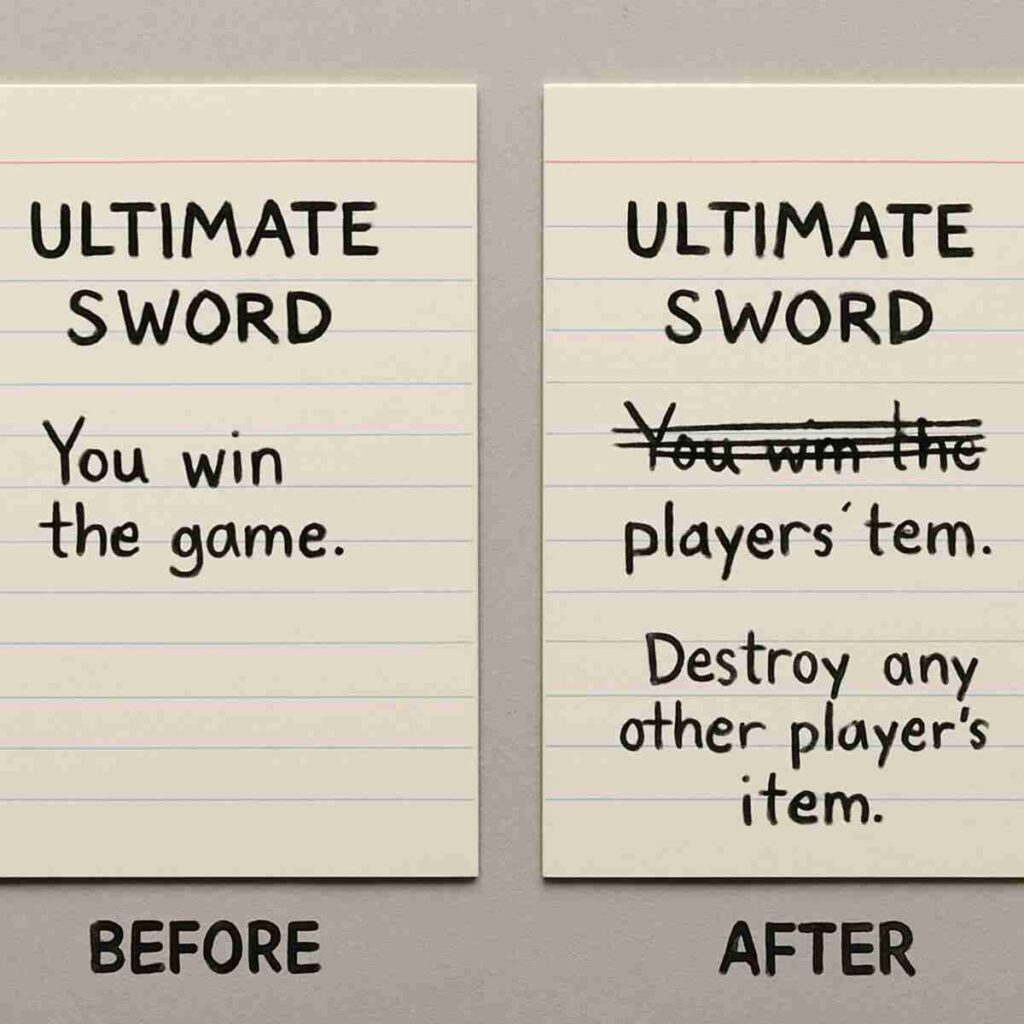
You found the “Awesome Sword”—the card that wins the game instantly. It makes every other card and decision feel meaningless. This is where balancing comes in. Balancing is the art of tweaking your rules and cards to ensure there isn’t one single “best” way to win. It’s the core of what makes a card game fun over multiple playthroughs: players feel rewarded for clever thinking, not just for luckily drawing one specific card.
That “Awesome Sword” is overpowered. The opposite is an underpowered card—one so useless no one ever wants to play it. Your job is to adjust these extremes. To fix an overpowered card, you can weaken it (a process called “nerfing”). Instead of winning the game, maybe the sword now just lets a player destroy one of an opponent’s items. For a useless card, you can strengthen it (“buffing” it) by adding a new ability, like letting its user draw an extra card. This is the heart of how to balance a game: making small changes and testing them again.
The goal isn’t to make every card equally powerful, but to make a variety of cards useful in different situations. A designer’s mental card game mechanics list always focuses on creating interesting choices. As you adjust cards, you might find that the rules themselves are the problem. A balanced card is worthless if no one understands it, which is why your next step is writing rules so simple that your friends won’t need to ask questions.
How to Write Rules So Simple Your Friends Won’t Need to Ask Questions
A brilliant game can fall flat if the rules are a confusing wall of text. The goal of your first rulebook isn’t to cover every edge case; it’s to get your friends playing in under five minutes. Thinking about how to write a good rulebook from the start is one of the most important steps in developing a card game.
The best way to present your rules is with bold headings and simple lists. This format is easy to scan during a game. Organize your single-page rule sheet into four essential sections:
- The Goal: Start with your Win Condition in one clear sentence (e.g., “The first player to get rid of all their cards wins.”).
- Setup: List the steps to start the game (e.g., “Shuffle the deck. Deal 7 cards to each player.”).
- On Your Turn: Describe the Core Loop (e.g., “1. Play a card that matches the top card’s colour or number. 2. If you can’t play, draw one card.”).
- Card Glossary: Briefly explain what any cards with special text or symbols do.
Before handing your rules to a friend, try this test: could you explain it to a curious child? This forces you to drop jargon and focus on the basics. This clarity is a cornerstone of playtesting best practices because it ensures players are testing your game, not their ability to decipher your writing. Once your rules are clear, you can apply the same principle to the cards themselves.
Art for Prototypes: Why Clarity Beats Beauty in Early Game Design
You’ve written the rules, but players will be staring at the cards. In these early stages, effective card game art and graphic design have one job: to communicate information instantly. Think of it like a road sign—clarity matters more than artistry. If a player has to squint to read text or ask “what does this drawing mean?” the game grinds to a halt.
The goal is to make the game playable from across a table. Use a thick black marker for important numbers. Colour-code different card types—maybe “Action” cards are blue and “Item” cards are white. A hand-drawn icon for “attack” (like a simple sword) is much faster to recognize than reading the word “Attack” for the tenth time.
This is why you should not hire an artist for your prototype. As you playtest, you’ll discover that some cards don’t work. You’ll want to throw them out, scribble new text on them, or tear them up. When creating a card game prototype, this freedom to change everything is your most powerful tool. Tying yourself to finished art too early makes it painful to kill a card that needs to go.
So, when is the right time? Think about professional art and custom playing card printing only after your game is undeniably fun. Once the rules and card effects are stable—and you’re no longer making major changes every game—then you can focus on making it look beautiful. For now, embrace the glorious mess of a hand-drawn prototype.
From Prototype to Polish: What Are the Next Steps for Your Game?
After playing with your hand-drawn cards, you’ve probably discovered that one card is an instant-win button and another rule confuses you. This is a success. You’ve just completed your first turn in the most important loop of game design: iterative design. The process is simple: play the game, find a problem, tweak a rule or card to fix it, and immediately play again. You are sculpting, chipping away at the parts that are boring or broken to reveal the fun underneath.
How do you know when your core game is stable? Watch your players. You’re on the right track when their questions change from “What does this card do?” to “Should I play my powerful card now or save it?” That shift from confusion to strategy is your goal. Effective playtesting best practices are about spotting these moments. The ultimate sign of success is when a game ends and someone says, “Let’s play again.” This is also how you begin to balance a game—not with spreadsheets, but by ensuring the experience feels competitive and rewarding.
Only when your core game consistently creates those fun, strategic moments have you earned the right to expand it. Resist the temptation to add dozens of new cards to a game that still feels wobbly. Once the foundation is solid, you can design new cards that add variety. Don’t worry about big-picture goals like self publishing vs finding a publisher; your only mission right now is to make your small, simple game undeniably fun.
Your Action Plan: 3 Small Steps to Take This Week
Your game idea now has a map. Developing a card game isn’t about a rare flash of genius, but a practical process of taking small, deliberate steps. Your journey from dreamer to designer begins now. Here is your first, non-intimidating assignment.
Your First Week Action Plan:
- Write your theme and win condition on a single piece of paper.
- Create a 20-card prototype using index cards, focusing on your core loop.
- Play the game against yourself one time, looking for one thing that’s confusing or broken.
The goal isn’t perfection; it’s progress. You’ve gone from someone with an idea to someone with a plan for one of the most rewarding creative projects you can tackle. Now go make your game.