

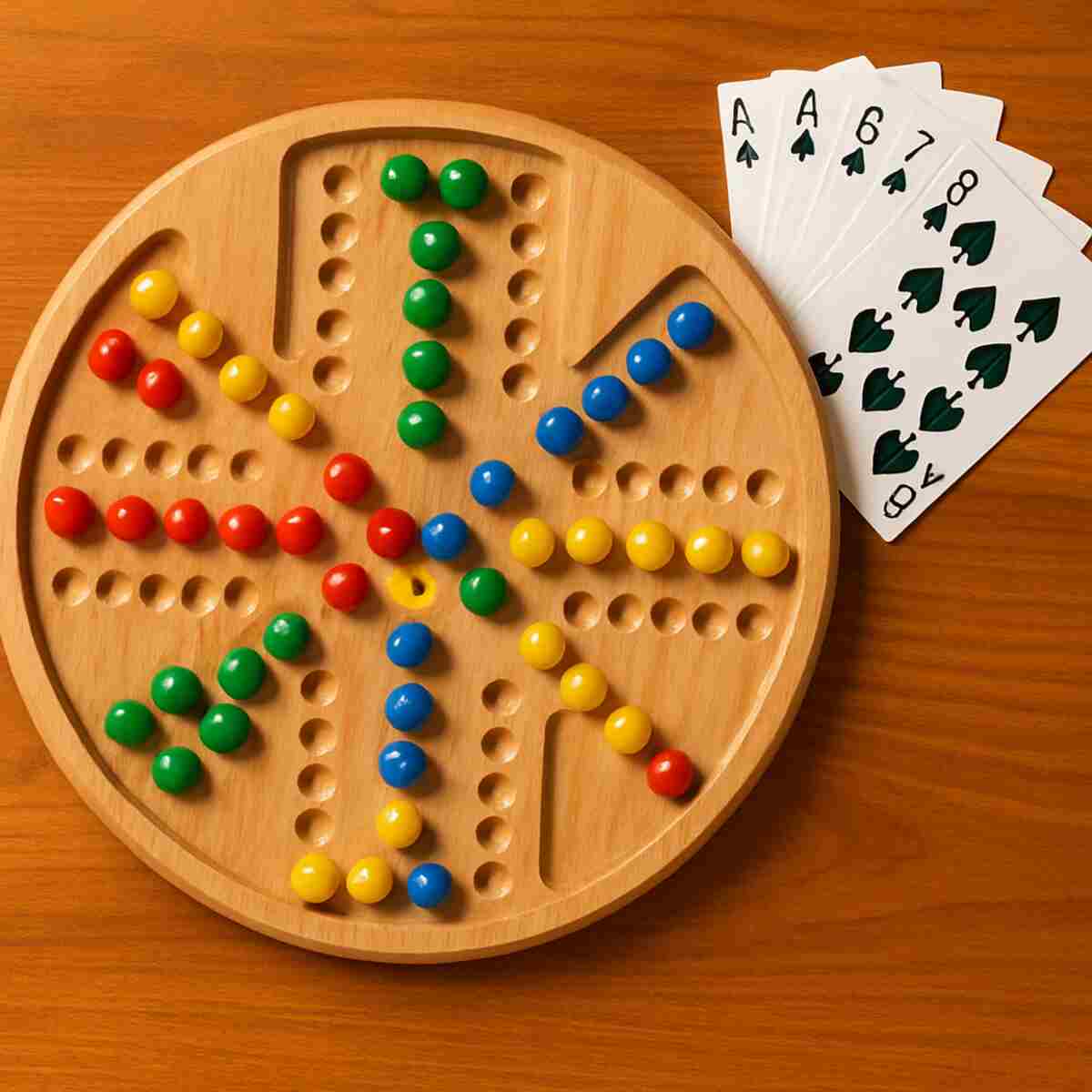

Remember the joy of a perfect dice roll sending an opponent’s piece back to the start? It’s a classic game night moment. But what if you could have that same satisfying thrill with more control and less random luck? This is the simple genius behind the marble board game with cards, a perfect blend of familiar fun and clever strategy. To learn more, check out qqdewa
At its heart, the goal is one you already know: be the first player to race all your marbles from your starting area, around the entire board, and safely into your “Home” zone. Instead of rolling dice, however, your fate rests in the cards you hold. A ‘5’ card moves you five spaces, a ’10’ moves you ten—you choose which card to play, giving you a delicious bit of control over your destiny each turn.
This single change makes it an engaging board game that uses cards instead of dice. The game opens up with exciting new choices. Do you use your high card to race ahead, or save that special Jack that lets you swap places with an opponent who’s just about to win? Common knowledge among players suggests these moments of strategic choice, not just blind luck, are what create the most memorable, laugh-out-loud victories.
Whether you’re looking for the perfect round marble board game for adults or a new favorite for family night, you’ve found it. Let’s get your marbles on the move by exploring the simple rules, the special powers of the face cards, and the basic strategies that will have you playing—and winning—in no time.
What Is This Game Called, Anyway? Unpacking “Pegs and Jokers,” “Wahoo,” and More
You might hear a friend rave about playing “Wahoo” at a family reunion, while another insists their favorite game is “Pegs and Jokers.” This can be confusing, as they both seem to describe racing marbles around a wooden board using playing cards. The truth is, they’re all part of the same fun, chaotic family of games that has been a homemade favorite for decades.
Think of it like the debate over “soda” versus “pop.” The names often change by region or by family, but the core concept is the same. “Wahoo” and “Pegs and Jokers” are two of the most common names you’ll encounter, but you might also see it called “Jokers and Marbles” or simply “the marble game.” Each name often comes with a slight twist or a unique house rule that makes that family’s version special.
No matter what name you hear, the fundamental goal remains constant: race your marbles to safety. The rules you learn here will give you the perfect foundation to play almost any version you come across. So whether the board is a polished heirloom or a brand-new set, you’ll be ready to jump in and play.
Your Tools for the Race: The Board, Marbles, and Cards
To get started, you’ll need three core elements that every version of the game relies on:
- The Game Board (your racetrack)
- The Marbles (your racing team)
- The Playing Cards (your engine)
The board itself is your map to victory. You’ll immediately notice distinct colored zones that are key to gameplay. Your four marbles begin in your colored Start area. From there, they enter the main path of holes winding around the board, known as the Track. The ultimate goal is to guide each marble up your matching colored path and into your Home zone. This layout is the classic design you’ll see in any round marble board game, perfect for adults and families.
Each player claims a color and its four matching marbles. Most games for four players require two standard 52-card decks, jokers included, all shuffled together. Instead of rolling dice, these cards are the heart of the game, giving you the power and strategy to make every move.
The Heart of the Game: How to Use Cards to Move Your Marbles
On each turn, the process is wonderfully simple: you’ll draw one new card from the deck and then choose one card from your hand to play. This choice is where the game’s fun and strategy begin to shine, replacing the random luck of a die roll with a decision that you control.
For most of your hand, the card values for marble movement are exactly what you’d expect. If you play a 9, you move one of your marbles forward 9 spaces along the track. A 4 moves you 4 spaces. It’s that straightforward. You simply count the holes and advance your piece, just like in any classic race game.
But what happens if you can’t make a legal move? You must still play a card. If none of the cards in your hand allow for a legal move, you simply choose one, place it in the discard pile, and forfeit your turn. It’s a tough break, but a crucial part of the game. The basic “play a card, move a marble” cycle is the foundation for how to play Pegs and Jokers or similar games. While most cards just move you forward, some have special powers, including the one you need to get a marble onto the track in the first place.
The First Big Step: Using an Ace to Get Out of “Start”
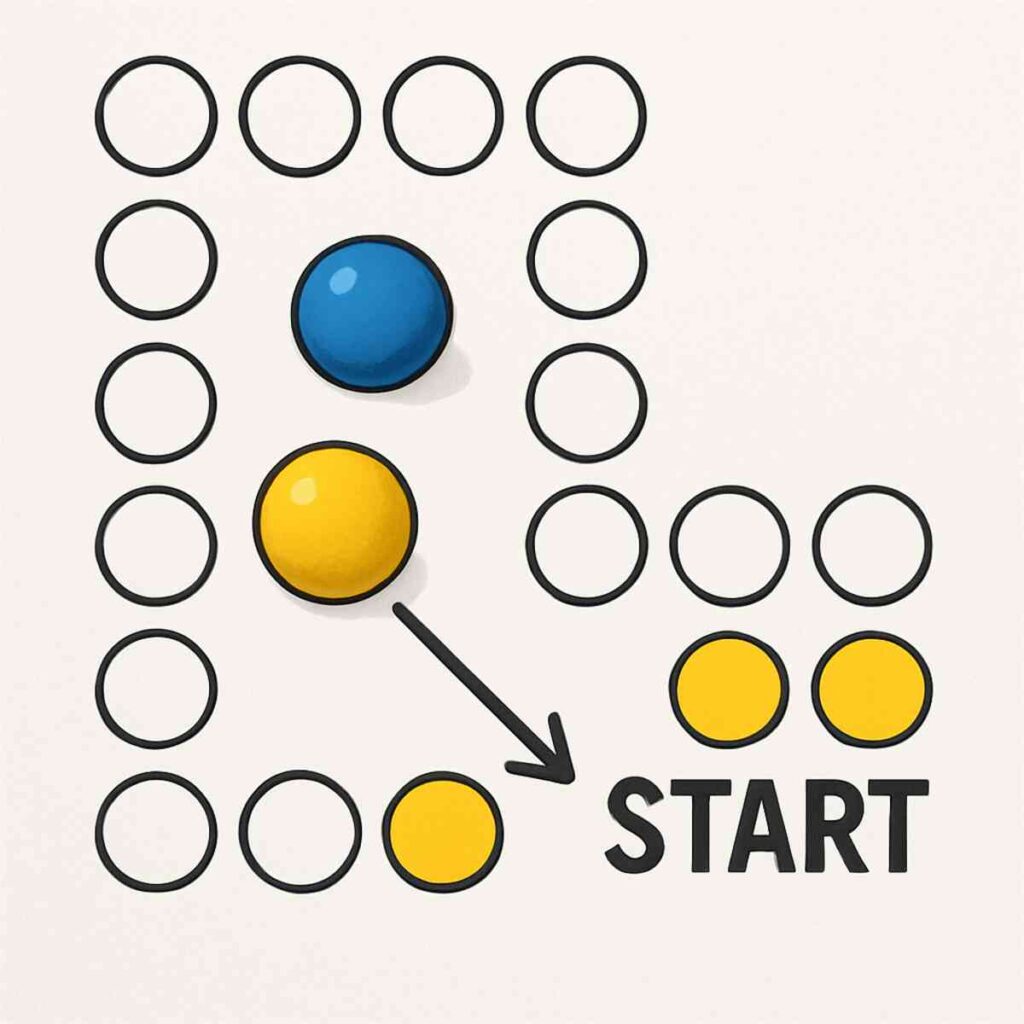
To get your marbles into the race, you can’t simply move them out of your “Start” area. You must play an Ace. Think of an Ace as your golden ticket—playing one allows you to take a single marble from your “Start” area and place it onto its designated entry space on the main track. Without an Ace, your marbles are patiently waiting for their chance to join the action.
Interestingly, the Ace has a dual personality. If all your marbles are already on the board, an Ace can also be played to move any one of them forward a single space. This flexibility is a core part of the game’s strategy. Having an Ace in your hand means you always have a choice: start a new piece on its journey or nudge another one closer to safety. This dual function makes the Ace one of the most valuable cards to hold, especially when recovering after an opponent sends you back to Start.
The “Sorry!” Moment: How to Send Opponents Back Home
Getting sent back to Start isn’t just a risk—it’s a move you can use to your advantage. This is where the game gets its delightful dose of “gotcha!” moments. Much like in classic games such as Sorry!, if you play a card that allows your marble to land on a space exactly occupied by an opponent, you send their marble all the way back to their Start area. They can’t just re-enter the track on their next turn; they’ll have to wait until they draw another Ace to get back in the race.
This single move is one of the most powerful offensive plays you can make. It can completely upend an opponent’s strategy, especially if they were nearing their Home stretch. Forcing a player back to square one is a key piece of strategy for the Jokers and Marbles game, turning a simple race into a dynamic back-and-forth battle where no lead is truly safe.
However, a player’s own colored entry space—the spot they first land on after leaving Start—is typically a “safe zone.” If your marble is resting on its own entry space, other players cannot land on it or send it home. This creates a crucial, though temporary, sanctuary, a vital detail among the sometimes lost rules for a homemade marble game. Mastering when to attack versus when to protect your own pieces is the heart of the game’s fun.
Unlocking Special Powers: What a Joker, Jack, and 4 Can Do
While most cards offer simple forward movement, the true game-changers are the cards with special powers. These can snatch victory from the jaws of defeat and transform the game from a simple race into a clever puzzle. The card values for marble movement aren’t always what they seem, especially with these three.
- Joker: This is the ultimate wild card. A Joker can be used as a substitute for any number card, from an Ace to a King. Need to move exactly 7 spaces to send an opponent home? The Joker can do it, providing a clear answer when the joker card rules need to be explained.
- Jack: Often called the “Swapper,” a Jack allows you to swap the position of one of your marbles with any opponent’s marble on the main track. If a rival is about to win and you’re stuck at the beginning, this card can instantly reverse your fortunes.
- Four: This card is unusual—it forces you to move one of your marbles backward 4 spaces. While that might sound like a penalty, it’s actually a brilliant strategic tool for getting into your Home zone if you’ve overshot the entrance.
Using these cards is the heart of any good strategy for the Jokers and Marbles game. That backward-moving 4 can be the only way to slide into Home without circling the board again. A well-timed Jack doesn’t just advance your position; it demolishes an opponent’s progress. Holding onto these cards until the perfect moment is a skill that separates new players from seasoned ones.
The Final Stretch: How to Move Your Marbles into “Home”
You’ve navigated the entire board, dodged opponents, and your marble is now at the doorstep of your colored lane. This is your “Home” zone, a safe area where marbles are protected. Once a marble is in this lane, it’s on a one-way trip to the finish—a core principle when learning how to play Pegs and Jokers.
However, there’s one final twist: you must land in your Home zone with an exact count. If your marble is three spaces away from an open spot in your Home lane, you must play a 3. If you only have a 5 or a 6, you’ve overshot it and can’t make that move. This is one of the most common stumbling blocks and a frequent question for those looking up the lost rules for homemade marble game versions.
This is precisely where that backward-moving 4 card becomes your secret weapon. If you accidentally pass the entrance to your Home zone, you don’t have to circle the board again. On a future turn, you can play a 4 to move backward and slide perfectly into position. Getting one marble home is an achievement, but in a chaotic 4-player fast track board game setup, winning requires moving all of them.
Stronger Together: The Secrets of Strategic Partnership Play
Just when you think you’ve mastered the game, adding a partner completely changes the landscape. While you can play with every person for themselves, the game truly shines when played in teams. In a classic 4-player fast track board game setup, you’ll typically partner with the person sitting directly across from you. Suddenly, you aren’t just trying to win—you’re trying to win together.
This partnership introduces a game-changing new ability: on your turn, you can move your partner’s marbles as if they were your own. If your teammate is stuck but you hold the perfect card, you can play it to move their marble and alter their fate. Your hand becomes a shared tool for your team’s success.
Once you get all your own marbles safely into your Home zone, your job isn’t over. You will continue to draw and play cards, but now every move must be used to help your partner. You become their dedicated assistant, working to clear their path, knock opponents out of the way, and race their remaining marbles to the finish. These strategic partnership marble game rules are what make team play so compelling and a top candidate for the best wooden marble chase game for friend and family gatherings.
Pegs and Jokers vs. Wahoo: Spotting the Key Differences
While the spirit of partnership is a common thread, the game you’re playing might go by different names, most often Pegs and Jokers or Wahoo. The most noticeable difference is often the board itself. A Pegs and Jokers set frequently uses a modular design with interlocking paddles, making it adaptable for different numbers of players. In contrast, Wahoo is typically played on a single, solid board, often a beautifully crafted wooden centerpiece.
Beyond the physical form, you’ll find small variations in the rules. One popular difference in how joker card rules are explained involves their power. In many Pegs and Jokers games, a Joker is a devastating weapon that moves an opponent’s marble. In many Wahoo circles, however, a Joker might be a “get out of start and move” card, giving your own marble a powerful boost.
Ultimately, in the friendly rivalry of Pegs and Jokers vs Wahoo, the choice is a matter of tradition and taste. The core fun—the clever card plays, the dramatic captures, and the thrill of helping a partner—remains the same. Both make a strong case for the best wooden marble chase game for any social gathering.
Fancy a Project? How You Can Make Your Own Marble Game Board
Part of the enduring charm of these games is that many boards are handcrafted. Creating your own is a surprisingly accessible project that turns the game into a personal keepsake. A well-made homemade marble game isn’t just a fun activity; it’s an heirloom that can be passed down.
You can find plenty of detailed DIY Wahoo board instructions online for specific layouts, but the basic toolkit is quite short. For a classic, sturdy board, you will generally need:
- A piece of quality wood, like oak or maple
- A drill press or hand drill with a guide
- A spade bit sized to fit your marbles
- Sandpaper and a wood finish for a smooth, professional feel
Consistency is the most critical part of the process. Ensure every hole is drilled to the same depth and is spaced evenly. This guarantees your marbles sit snugly and the path is fair for every player. A drill press makes this easy, but a simple drill guide or marked tape on your drill bit can work wonders. Getting the holes right is what transforms a piece of wood into the best wooden marble chase game board, ready for decades of fun.
Your Blueprint for Fun: Bringing It All Together for Game Night
This game offers a perfect recipe for fun, blending the luck of the draw with the satisfaction of playing the exact right card to zip ahead or send a rival home. You’re not just looking at pieces on a board; you’re seeing the potential for unforgettable moments.
Teaching this marble board game with cards is simple. When you gather your friends, just point to the finish line: “Our goal is to get our marbles Home.” Then, show them how any number card moves a marble that many spaces. This creates a clear foundation in under a minute, getting everyone ready to play instead of bogged down by rules.
Once they grasp that, reveal the magic. Pull out a Jack to explain its swapping power or show how an Ace gets them into the action. With this simple approach, you won’t just be teaching a game; you’ll be starting the fun immediately.
The next time you need a great round marble board game for adults and family, remember that you’re not just opening a box. You are setting the stage for laughter, friendly rivalries, and stories that will be retold long after the marbles are put away. Go on, deal the cards and get ready to make some memories.
