


Looking for a new addition to your game night that’s full of surprising twists? The Shoot the Moon card game is a fantastic choice that flips the script on what it means to win. Unlike almost any game you’ve played before, the primary goal here is to finish with the lowest score possible. In practice, this means every round is a tense exercise in avoiding certain cards as if they were hot potatoes. Check out the Best info about Link studiobet78.
This style of play, known as a trick-taking game, might feel familiar if you’ve ever tried to learn how to play the Hearts card game, which shares a similar DNA. In Shoot the Moon, all the Heart cards and the notorious Queen of Spades are “point cards”—and you don’t want them. Your objective is to skillfully offload these cards onto your opponents, forcing their scores up while yours stays comfortably at zero.
But what about the game’s famous name? This is where the ultimate high-risk, high-reward strategy comes into play. Instead of avoiding the point cards, a daring player can try to capture all of them. This is called “Shooting the Moon.” Succeed, and you hand your opponents a massive point penalty; fail by even a single card, and the disaster is all yours.
Ready to turn game night on its head? This guide covers everything from your first hand to that legendary all-or-nothing move, ensuring you’re ready to teach your friends and play a thrilling first round.
The Golden Rule: How to Win by Scoring Nothing
If the goal is to have the lowest score, how do you actually get points you don’t want? The secret is to avoid winning tricks that contain “point cards.” Think of these cards as hot potatoes—you want to make sure another player is stuck holding them at the end of a round. In this game, only two types of cards will add to your score: Hearts and one very specific Spade.
The scoring itself is simple to remember. At the end of each round, players check the cards they’ve won and add up their points based on this breakdown:
- Each Heart card you took = 1 point
- The Queen of Spades (a.k.a. “The Black Lady”) = 13 points
That’s it. As you can see, capturing the Queen of Spades is a huge blow, instantly giving you half of all the points available in a round. All other cards—Clubs, Diamonds, and the other Spades—are worthless, carrying a value of zero.
You’ll keep playing rounds, tallying scores until one player’s total hits 100 points. The moment that happens, the game ends. However, that person doesn’t win. The player with the lowest score at that moment is declared the winner.
Your First Hand: How to Set Up and Deal for 3 or 4 Players
Ready to play your first round? All you need is a standard 52-card deck with the jokers removed. Choose a dealer, give the cards a good shuffle, and you’re set. The way you deal changes just a bit depending on whether you have three or four players, but both methods are incredibly straightforward.
For a four-player game, the setup is perfectly neat. The dealer deals out all 52 cards clockwise, one at a time, until everyone has a hand of 13 cards. With the deck completely distributed, there are no leftover cards, making this a common and balanced way to begin a game of Hearts or its variations like the Black Lady card game.
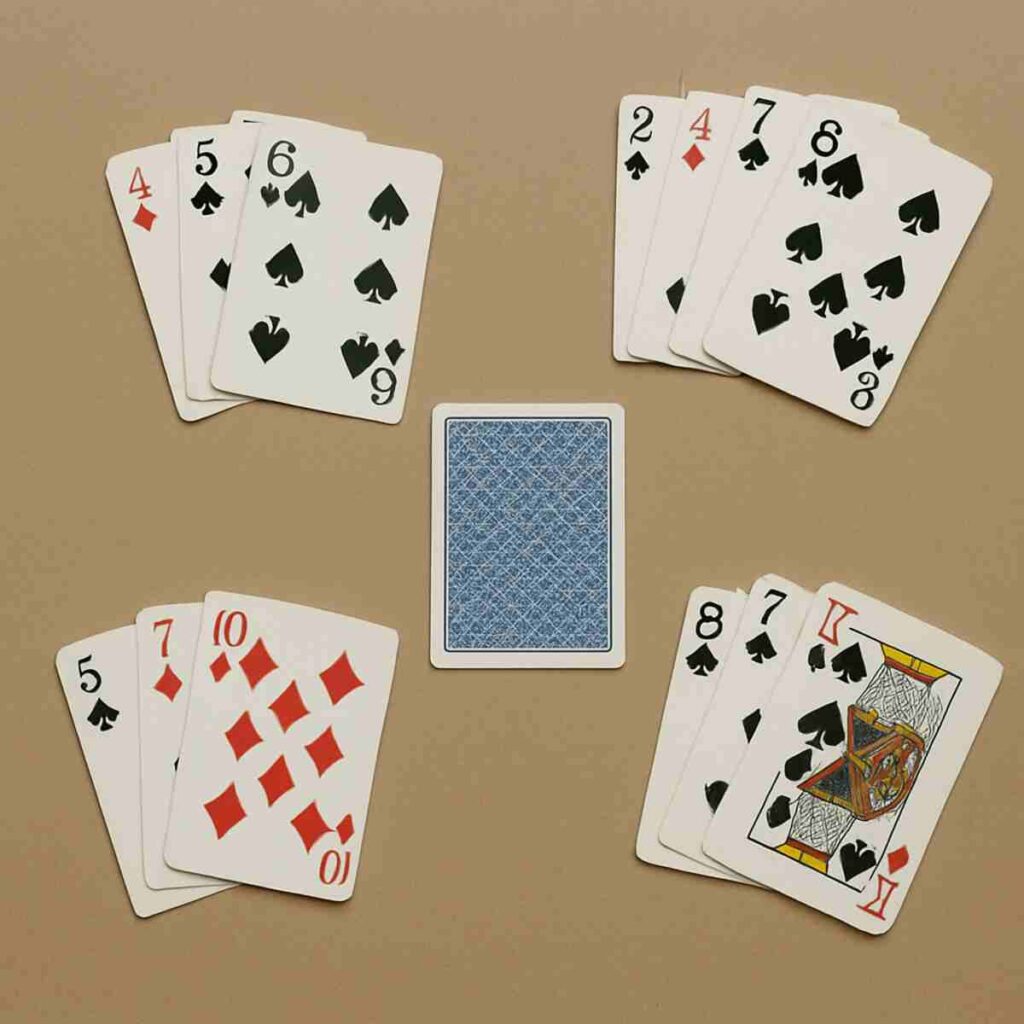
Playing with three people is where a small, interesting twist comes in, making this one of the best card games for three players. In this case, the dealer gives each person 17 cards. This leaves one card leftover, which is placed face-down in the center of the table. This special card is called “the kitty.” Whoever wins the very first trick of the round also takes the kitty, adding it to their pile of won cards (and any points it may contain!).
Once the cards are dealt and everyone has picked up their hand, there’s one crucial step before play begins: deciding which three cards to pass to an opponent.
The First Strategic Move: What to Pass and Why
This first decision, made before any cards are even played, is your best chance to improve your hand. The goal of passing is simple: you want to give an opponent three cards that are likely to cause them trouble later. Think of it as handing off a few small time bombs. You’ll select three cards from your hand, place them face down, and pass them to an opponent (typically the player on your left, though rules can vary). Everyone does this at the same time, so you’ll also be receiving three new cards.
The most dangerous card in the game is the Queen of Spades, worth a whopping 13 points. A straightforward strategy is to get rid of your highest Spades. If you’re holding the Ace, King, or even the Queen of Spades herself, passing them away can save you from being forced to take her in a later trick. It’s a simple but effective way to shift a huge risk onto someone else.
Beyond just passing high cards, another clever strategy is to empty your hand of a particular suit. For example, if you only hold two or three Diamonds, you could pass all of them. This is called “voiding” a suit. The advantage? If a player leads a trick with a Diamond later on, you won’t have any to play. This frees you up to discard a dangerous point card, like a Heart, on that trick instead of being forced to follow suit.
After everyone has selected their three cards to pass, you slide them face down to the designated player. Once all players have picked up their new cards, the first trick can begin.
How to Play a Trick (and Not Get Stuck with Points)
The game unfolds in a series of rounds called “tricks.” For the very first trick of the game, the player holding the 2 of Clubs must play it to start—this is called “leading the trick.” Play then proceeds clockwise. Each player will play one card to the center of the table, and after everyone has played, the trick is over. The goal is to avoid winning tricks that contain any point cards.
The most important rule for playing Hearts and its variants is following suit. This means that if the first player led the trick with a Club, every other player must also play a Club if they have one. The player who plays the highest-ranking card of the suit that was led wins the trick and takes all the cards played. For example, if a player leads the 5 of Spades, and others play the 3, 9, and Jack of Spades, the person who played the Jack wins the trick.
But what happens if you can’t follow suit? This is where the core strategy comes into play. If a player leads with a suit you don’t have in your hand, you are free to play any card you want. This is your golden opportunity for avoiding points in a tricking game. When you can’t follow suit, you can discard a pesky Heart or even the dreaded Queen of Spades onto the pile, forcing the winner of that trick to take those points.
Whoever won the previous trick collects the cards and places them face down in their own pile to be scored later. That player then starts the next trick by leading any card they choose (with a few exceptions, which we’ll cover later). This continues until all cards have been played. While the basic goal is to avoid points, there’s a high-risk, high-reward strategy that turns this entire concept on its head.
The Big Gamble: What ‘Shooting the Moon’ Really Means
While the main goal is to avoid points, the game’s most thrilling move asks you to do the exact opposite. To “shoot the moon” is to attempt the ultimate gamble: intentionally trying to win all of the point cards in a single hand. That means capturing all 13 Hearts plus the notorious Queen of Spades. This is the riskiest strategy you can attempt, but it comes with a massive payoff.
The reward for this incredible feat completely flips the game’s scoring on its head. If you successfully shoot the moon, you don’t receive any points. Instead, every other player in the game is penalized with a massive 26 points. In a game where the goal is to have the lowest score, landing a 26-point blow on all your opponents can instantly catapult you from last place to first.
However, the name “Shooting the Moon” implies a huge risk, and the penalty for failure is just as severe as the reward is sweet. If you try to take all the point cards but miss even one—if another player manages to sneak just a single Heart—the plan backfires spectacularly.
- If you SUCCEED (take all 26 points): You score 0. Every other player scores 26.
- If you FAIL (take 25 points or fewer): You are penalized with all the points you collected. Some variations even have a flat 26-point penalty for a failed attempt.
Attempting this move changes the entire dynamic of a round, turning every trick into a tense moment. It’s what makes the game so exciting. Of course, you don’t have to go for such a high-stakes play. Most of the time, your best bet is to simply play smart and stay safe.
Your Best Defense: 3 Simple Strategies for Avoiding Points
While shooting the moon is an exciting gamble, most hands are won through smart, defensive play. Mastering how to avoid taking points is the game’s core skill, and these simple strategies will help keep your score low.
A powerful defensive move is to “bleed” a suit you feel is dangerous. Let’s say you’re holding high Spades, like the Ace and King, but not the Queen. By leading with your high Spades early in the hand, you force the other players to play their Spades. This can successfully draw out the Queen of Spades from an opponent’s hand, making them give those 13 points to someone else. This is a great example of when to lead with a high card to control the game.
In the same spirit, learning to make a strategic sacrifice is key to avoiding points in a tricking game. Imagine you suspect the Queen of Spades is about to be played on a trick you are likely to win. If you have the chance to take a trick that contains only one or two Hearts instead, do it! Intentionally taking a small 2-point hit is much better than getting stuck with the 13-point Queen. It’s about choosing the lesser of two evils to protect your score in the long run.
Finally, never underestimate the power of your lowest cards. A card like the 2 of Clubs might seem useless, but it’s actually one of your best friends. It’s a nearly guaranteed way to lose a trick on purpose, ensuring you don’t have to pick up any unwanted points. Holding onto these safe, low cards gives you an escape route when things get tense. Running out of safe cards leads to a critical decision: whether you should be the one to “break” Hearts and change the game’s dynamic.
A Critical Decision: When Should You ‘Break’ Hearts?
A crucial rule governs the game’s most dangerous suit. In this trick-taking card game, you cannot lead a trick with a Heart. This simple restriction creates a lot of suspense, as players wait for the moment when the floodgates finally open. The only time this rule changes is after a Heart has already been played on a previous trick, a moment known as “breaking” Hearts. This is a fundamental concept in learning how to play the Hearts card game.
The act of breaking Hearts usually happens when a player cannot follow the suit that was led. For example, if Carol leads with a Diamond but you have no Diamonds left in your hand, you are free to discard a card from another suit. If you choose to play a Heart in this situation, you have just “broken” Hearts for the rest of the hand. From that point on, any player can start a new trick by leading with a Heart, which often dramatically changes the flow of the game.
Deciding when to do this is a major part of your strategy. The question of whether it is better to break Hearts early is a constant dilemma. If you have several low Hearts, breaking them might be a good way to force other players with high Hearts to start taking points. Conversely, if you’re holding dangerous cards like the King or Ace of Hearts, you’ll want to delay breaking them for as long as possible. This core rule adds a layer of tension, but it’s not the only way to play.
Spice Up Your Game Night: Two Popular Rule Variations
Once you’ve played a few games of Hearts, you might be looking for ways to add a new layer of excitement. The beauty of a classic like Hearts is that it has inspired many fun variations. These optional rules aren’t necessary to enjoy the game, but they can offer a fresh challenge once everyone at the table feels confident with the standard rules.
One of the most common and simple twists is known as the Omnibus Hearts variant rules. In this version, another special card is added to the mix: the Jack of Diamonds. Unlike the Queen of Spades and the Hearts cards, this one is a bonus. The player who ends up taking the trick that contains the Jack of Diamonds gets to subtract 10 points from their score. This introduces a fascinating new decision: is it worth risking a few Heart points to capture that valuable Jack?
For a completely different flavor of trick-taking, many players also enjoy the game of Spades. Understanding the fundamental Hearts vs Spades game differences highlights what makes each game unique. While the basic instructions for the “Black Lady” card game (Hearts) are all about avoiding points, Spades is about predicting success. In Spades, players bid on how many tricks they believe they can win, making it a game of calculated aggression rather than careful avoidance.
These variations are fantastic for keeping your game nights interesting, but don’t feel you have to introduce them right away. The classic game of Hearts, with its subtle strategy and the thrilling risk of Shooting the Moon, has more than enough depth to keep you and your friends entertained for hours.
You’re Ready to Play: Your Winning Game Plan
You now have the entire flow of the game down: from passing unwanted cards and playing through tricks to tallying the final score. You’re ready to deal a hand and take your first trick.
With every hand you’re dealt, you’ll face the central choice of this card game. You can play cautiously, meticulously avoiding every Heart and the dreaded Queen of Spades. This is a solid path for understanding how to win at Hearts-style games, focusing on careful play and risk management.
Or, you’ll look at your cards and feel that spark of daring. You’ll ask yourself, “Is this the hand where I risk it all?” This core tension is what makes the Shoot the Moon card game so replayable and provides a new trick-taking strategy to master—one built on audacity.
With the rules and core strategies in hand, you have the confidence to begin. Grab a deck of cards, a few friends, and deal your first hand. The only thing left to discover is just how satisfying it feels to win.